





Standing at the End of the Year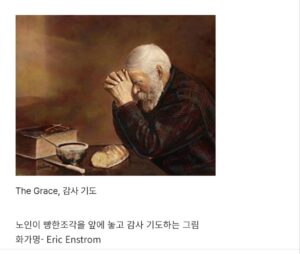
“After He said this, He showed them His hands and His side. Then the disciples rejoiced when they saw the Lord.”
(John 20:20)
It was the year 1918—a time of hardship and confusion as the world reeled from the devastation of World War I. In a small mining town called Bovey, Minnesota, there lived a Swedish immigrant named Eric Enstrom, who ran a modest photography studio.
One day, an elderly man entered the studio. He looked utterly worn down by life—his hair white with age, his clothes tattered. He had come in to sell shoe dusters. Clearly exhausted, the old man asked if he might rest for a moment. Apologetically, he also asked if he could have a cup of tea. Moved by compassion, Enstrom offered him some bread and a small bowl of soup.
Then something remarkable happened.
The old man sat down before the simple meal of bread and soup and bowed his head in prayer, giving thanks. In that moment, Enstrom felt a deep stir in his heart—a sense of awe and holy trembling. That frail and impoverished old man suddenly appeared to him as a great man.
Enstrom thought to himself,
“This man may not possess much in this world, but he has something far greater than many others. He knows how to give thanks.”
Though poor and weary, the old man possessed a grateful heart. In his simple prayer of thanksgiving, Enstrom realized that this man was, in fact, richer than anyone else in the world.
Right then and there, Enstrom took the man’s photograph.
Later, Enstrom’s married daughter, Ronda Nyberg, saw the black-and-white photograph and was deeply moved. She painted it as an oil painting. That painting—depicting the old man praying in gratitude—came to be known as “The Grace.” Many of us have seen it at least once. It has hung on the walls of countless American homes.
The English title, The Grace, deliberately points to that moment—that grace, that sacred encounter—when the old man offered thanks over a humble meal of bread and soup. This image, both the photograph and the painting, was later selected as the official state photograph of Minnesota in 2002.
On the evening of the resurrection, the disciples were gathered in the same place where they had shared the Last Supper with Jesus. Their hearts were still gripped by fear, and the doors were tightly shut.
The risen Lord came to them—not by opening the door, but by appearing among them. His resurrected body was no longer confined by space.
The disciples were stunned. What they saw went beyond their faith and imagination. They did not know how to comprehend it.
Jesus spoke first: “Shalom.”
The apostle Paul later interpreted this peace as “the peace of God, which surpasses all understanding, guarding our hearts and minds” (Philippians 4:7).
After speaking peace, Jesus showed them His hands and His side to assure them that it was truly He. The pierced hands of Jesus became an unforgettable image in their hearts—an image of grace, much like the praying old man.
When Thomas, who had not been present, returned, the disciples excitedly testified about what they had seen—the nail-marked hands and the pierced side. Thomas resisted their testimony, but Jesus appeared again and invited Thomas to touch the marks for himself.
Then Jesus said,
“Do not be unbelieving, but believing.”
Thomas became the first person to touch the nail marks in the risen Lord’s hands, and from his lips came the greatest confession of faith:
“My Lord and my God!” (John 20:28)
This is the climactic confession of the Gospel of John.
The nail marks in Jesus’ hands are the marks of forgiveness—the scars (stigmata) of the One who bore all our sins and transgressions. The apostle Paul even declares that he himself bears such marks in his body (Galatians 6:17).
Today, the Lord invites us as well—to see and to touch those marks.
As another year comes to a close, and as we send off the year 2025, the Lord calls us to behold those scars and to become people who believe and give thanks.
Heavenly Father,
May we, like Eric and Ronda, behold Your grace as if capturing it in a photograph.
May we look upon the nail-scarred hands of Christ, believe, and give thanks.
We pray this in the name of Jesus Christ.
Amen.
Shalom!
May the end of this year and the beginning of the next be warm and grace-filled.
May the new year bring you renewed health and hopeful steps forward.
New Year Blessings!
In Christ,
“May the God of hope fill you with all joy and peace as you trust in Him, so that you may overflow with hope by the power of the Holy Spirit.”
(Romans 15:13)
By Rev. Jaewoong Chang
